



Creatine has a PR problem.
Depending on where you look ( Enter stage left INTERNET 👋 ), women are told creatine will:
Make them bulky
Cause weight gain they “can’t lose”
Damage their kidneys
Mess with hormones
“For men only”
Or be unnecessary unless you’re a bodybuilder
None of this holds up under scientific scrutiny.
Creatine is one of the most studied supplements in human history, and much of the fear around women taking it is rooted in outdated assumptions, not data. Let’s separate the noise from the evidence.
What creatine actually is (and isn’t)
Creatine is a naturally occurring compound found in:
Muscle tissue
The brain
Foods like red meat and fish
Your body already produces it. You already use it.
Its primary role is to help regenerate ATP — the molecule your cells use for quick energy. That matters not just for lifting weights, but for:
Muscle contraction
Brain energy demands
Short bursts of power
Cognitive function under stress
Creatine is not a steroid.
It does not alter hormones.
It does not “override” your physiology.
Fake news #1: “Creatine will make women bulky”
This is the most persistent myth — and the least supported.
Muscle growth requires:
Progressive resistance training
Adequate protein
Caloric surplus
Time #consistency
Creatine does not create muscle out of thin air. It supports training quality, which can improve strength and lean mass over time — the same way better sleep or better recovery would.
For women, research consistently shows:
Small increases in lean mass (not bulk)
Improved strength
No masculinizing effects
If creatine made women bulky, the fitness industry would look very different.
Fake news #2: “Creatine causes fat gain or scale weight that doesn’t go away”
This one is partially misunderstood and heavily exaggerated.
Creatine increases intracellular water in muscle cells. That means:
Water is pulled into the muscle, not under the skin
This is associated with better muscle function, not fat gain
Yes, some women may see:
A small scale increase (often 1–3 lbs)
Especially in the first 1–2 weeks
That is not fat.
It is not permanent.
And it often stabilizes once muscles are saturated.
Importantly: intracellular water is not the same as bloating.
Fake news #3: “Creatine is bad for your kidneys”
This is one of the most common concerns — and one of the most thoroughly debunked.
In healthy individuals, long-term creatine use has not been shown to impair kidney function. The confusion comes from the fact that creatine can increase creatinine levels in blood tests — a marker doctors use to assess kidney function. Consult with your physician, but healthy individuals have little to fear here. If you have a known kidney issue then of course you should not do anything before speaking to your doctor.
Creatinine ≠ kidney damage.
It’s a byproduct of creatine metabolism.
This distinction matters, and it’s where fear often replaces understanding.
Fake news #4: “Women don’t need creatine”
This argument usually sounds like:
“You don’t need it unless you’re lifting heavy.”
But creatine’s benefits extend far beyond muscle size.
In women, research has shown benefits related to:
Strength and power
Muscle preservation during aging
Cognitive performance
Fatigue resistance
Possibly mood and brain energy availability
As women age, muscle loss accelerates and recovery capacity declines. Creatine appears to be more beneficial, not less, in this context.
Creatine and women over 40: why this matters more, not less
Perimenopause and menopause bring changes in:
Muscle protein synthesis
Recovery capacity
Neuromuscular efficiency
Bone density
Cognitive resilience
Creatine doesn’t “fix” these changes — but it can support the systems under more strain.
This is why research increasingly looks at creatine not as a bodybuilding supplement, but as a healthspan supplement.
What the science actually supports
Based on the current body of research, creatine in women is associated with:
Improved strength and training output
Preservation of lean mass
No adverse hormonal effects
No kidney damage in healthy individuals
Potential cognitive and neurological benefits
High safety profile when used appropriately
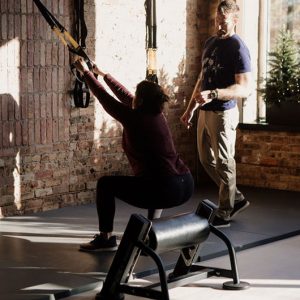
This doesn’t mean every woman needs creatine. It means the blanket fear is not justified. I don’t have many of my female clients on creatine tbh. They’re doing so many other things right it isn’t really a needed factor. They feel great after we do a 12 or 24 week cycle of coaching. But some have tried it and enjoy it.
 Practical considerations for women
If a woman chooses to take creatine, evidence supports:
Dose: 3–5g per day
Form: Creatine monohydrate (simple, effective, well-studied)
Timing: Not critical — consistency matters more
No cycling required.
No “on/off” protocols needed.
The real question women should ask
Instead of:
“Will creatine make me bulky?”
A better question is:
“Does this support my training, recovery, and long-term muscle health?”
For many women — especially those training consistently — the answer may be yes.
But supplements are tools, not solutions. Creatine cannot compensate for:
Poor sleep
Inadequate protein
Chronic under-fueling
Inconsistent training
High stress with low recovery
Used in the right context, it’s supportive. Used in isolation, it’s irrelevant.
Bottom line
Creatine is not a magic pill.
It’s also not something women need to fear.
Most of the pushback against creatine for women is cultural, not scientific. And like many nutrition myths, it persists because it sounds intuitive — not because it’s true.
The science is clear:
Creatine is safe, well-studied, and potentially beneficial for women, especially those who train, want to preserve muscle, and care about long-term health.
The decision to use it should be informed — not driven by outdated narratives.
– Your Coach, Matt
Matt@reveal-weightloss.com to book your CLARITY call